The Dixie
The Dixie, 1950 to 1980
Electric drive, a pilothouse moved ten feet forward, choir students in costume on the top deck, and Tag Huffman's twenty-two seasons.
The upgrade of the powertrain to diesel-electric in 1949 allowed Ungeright to make a few practical improvements to the Dixie, while retaining its heritage.
The Pilothouse
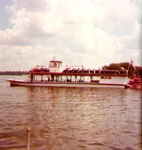
Traditionally the pilothouse was located closer to the engine room, near the center of the top deck. The main reason for this was to allow the engine to be controlled from the pilothouse with various levers and pulleys. The diesel-electric setup did not require "mechanical" controls. This allowed Ungeright to move the pilothouse forward for better visibility.
In 1950 the pilothouse was moved forward 10 feet. It was also modified to include new hardware for controlling the paddlewheel's electric motor. The new hardware consisted of a motor control switch and grid resistor from a 1920's era interurban. The whistle was also moved from the stern to the top of the pilothouse.
Ungeright installed a Public Address system and began playing relaxing music during the excursions. The music was played on a 45 record player located in the pilothouse. When the Dixie hit big waves it could cause the records to skip, which added some humor to the trips.
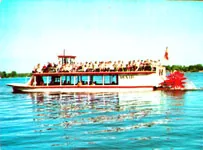
Fare on the Dixie in this era: 65 cents.
The Huffman Era - 1958 through 1980
By 1958 Earl Ungeright was considering retirement, and was looking for someone who would carry on with the boat in its past tradition. Earl found the right buyer when he met Ernest "Tag" Huffman.
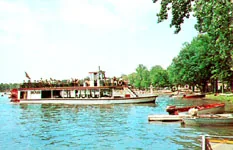
Huffman purchased Dixie Camp from Ungeright in 1959. By now the Dixie was over 30 years old, and Huffman respected the historical significance of the boat. Over the years he made several practical improvements to the Dixie, but was careful to preserve the boat's appearance.
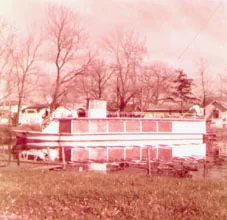
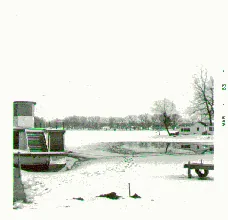
Fare on the Dixie in this era: 75 cents.
Showboat Production
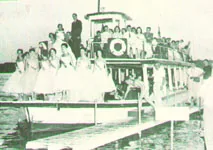
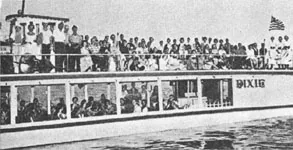
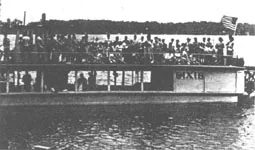
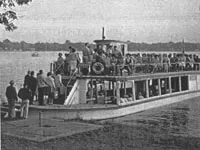
In 1955, Varner Chance began an annual stage production for the Epworth Forest Choir School. The production was known as Showboat, and was inspired by the theme of the 1950 Hollywood musical of the same name. The first nine Showboats actually used the top deck of the Dixie as the stage. The Dixie would go to Epworth Forest, pick up the students (in full costume dress) and proceed to the City Street Landing at North Webster where the performance took place. By 1964 the production had become too large for the Dixie, and Showboat was moved to the newly completed Amphitheatre at Epworth Forest. The Dixie still picked up the students and delivered them to the Amphitheatre, but the trip was much shorter than traveling to the landing at North Webster. The Dixie participated in the Showboat production until 1981, when new owners decided it was not cost effective to volunteer the Dixie's services for the 20-minute trip.
Deck Improvements
Since 1929, the upper deck had been re-coated with a new layer of tar each fall. By 1963 the tar and gravel coating was 2 inches thick and weighed several tons. Huffman began replacing the original tar and gravel decking with fibreglass during the fall of 1963.
The fibreglass decking proved to be much lighter and more durable than the old tar and gravel material. When the new fibreglass deck was completed in the spring of 1964, the Dixie floated over one inch higher in the water!
Huffman re-fibreglassed the bow and top decks in the spring of 1980. Due to advances in materials and techniques, the 1980 fibreglass decking has fared very well, and was still in use aboard the Dixie a quarter of a century later.
The Concession Stand
Before 1963 the concession stand was simply a popcorn popper and ice cooler butted-together near the front of the lower deck. Huffman built an enclosed countertop area around these appliances. This created a true concession stand, complete with storage, a speaking tube for communicating with the pilothouse, and seating for the concessionaire.
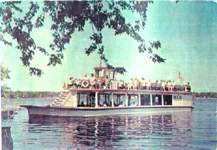
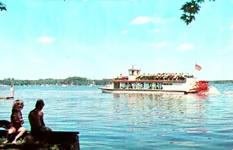
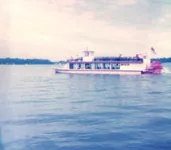
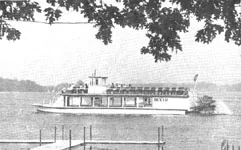
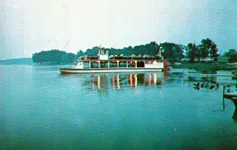
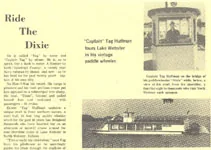
Aside from Joe Breeck, Huffman operated the Dixie much longer than any other owner; past or present. After nearly 22 years, Huffman sold the Dixie in late 1980 and retired. Over the years he had maintained the Dixie religiously. To his credit, the Dixie retained its traditional appearance, and was still very similar to its original 1929 design.